Does PPF Interfere With Parking Sensors or Vehicle Cameras?
.jpg)
High-quality paint protection film does not interfere with parking sensors or vehicle cameras when installed correctly using precision techniques. For vehicle owners considering paint protection film in Little Rock, clear thermoplastic polyurethane film provides durable impact resistance for modern vehicles without disrupting sensitive advanced driver assistance systems (ADAS).
Modern vehicles rely on an array of ultrasonic sensors, radar units, and high-definition cameras embedded into bumpers, grilles, and exterior mirrors. Because these safety systems safeguard lane-keeping, automated emergency braking, and parking assistance, car owners naturally worry that covering bumper panels with protective film might cause false alarms or distort camera feeds.
Understanding the physics of automotive sensors, the optical properties of premium film, and the installation methods used around technical hardware ensures your vehicle remains fully protected without compromising a single driver-assist feature.
Will Paint Protection Film Disrupt Parking Sensors or Exterior Cameras?
Paint protection film will not disrupt parking sensors or exterior cameras when the film is optically clear, non-metallic, and installed with proper precision. Premium films are engineered from aliphatic thermoplastic polyurethane, an electromagnetic-neutral polymer that permits sound waves, radar pulses, and light signals to travel freely through its structure.
Interference only arises when lower-grade materials are used, when air or moisture remains trapped over a sensor head, or when an installer covers camera lenses that require open optical paths. When installed by experienced technicians using precision digital plotter patterns, safety equipment functions exactly as engineered by the vehicle manufacturer.
The three primary categories of electronic monitoring hardware on vehicle exteriors include:
- Ultrasonic Parking Sensors: Small, circular pucks mounted along front and rear bumper covers that emit high-frequency sound waves to detect close-range physical objects during low-speed parking maneuvers.
- Radar and Forward Collision Units: Transmitters positioned behind front bumper fascia or central grille emblems that calculate vehicle distance and speed for adaptive cruise control and forward collision avoidance.
- Optical Cameras: Exterior lens modules located in windshield headers, front grilles, side mirrors, and trunk lids that power backup views, 360-degree surround monitors, and lane-centering systems.
Each of these systems interacts with protective film in specific ways based on the physics of signal transmission.
How Ultrasonic Parking Sensors Respond to PPF
Ultrasonic parking sensors use high-frequency acoustic vibrations, typically between 40 and 50 kilohertz, to calculate proximity to nearby obstacles. The sensor sends out a sound burst and measures how quickly that echo bounces back off a curb, wall, or vehicle.
Because acoustic waves pass cleanly through a uniform 8-mil layer of flexible urethane, a properly seated film layer does not block ultrasonic signals. However, the rubber decoupling ring surrounding the sensor must never be restricted. If film bridges over this ring or traps liquid within the perimeter channel, the sensor diaphragm cannot vibrate cleanly, which results in continuous beeping or false alert tones.
How Exterior Vehicle Cameras Interact With PPF
Vehicle cameras function through light transmission, capturing visual data across wide-angle glass or polycarbonate lenses to project parking lines or read highway lane markers. Exterior cameras must maintain pristine visual transparency to feed sharp images to the dashboard display and onboard image processors.
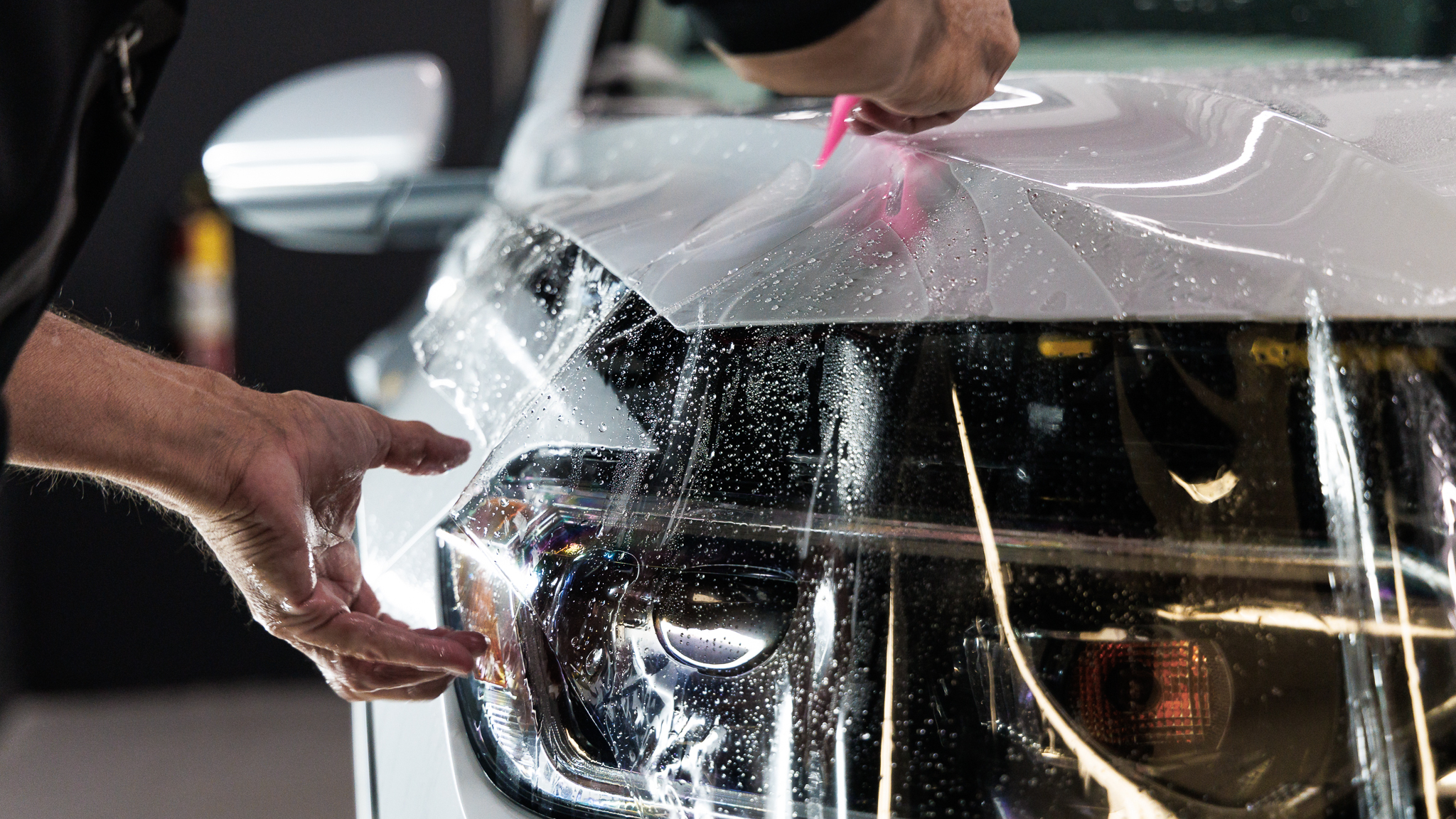
While premium paint protection film has an optical clarity comparable to glass, automotive detailers generally avoid wrapping directly over camera lenses. Curved camera lenses feature unique hydrophobic or anti-glare glass coatings. Applying film over a tiny curved lens can create slight visual refraction, minor distortion, or edge flare at night. Instead, installers wrap up to the edge of camera housings, leaving the lens open for unimpeded optical processing.
How Radar and Forward Collision Systems Respond to PPF
Radar modules operate on high-frequency electromagnetic radio frequencies, frequently within the 76 to 81 gigahertz spectrum, to detect objects several hundred feet down the road. Radio waves travel easily through non-conductive, dielectric materials such as standard automotive plastics and clear thermoplastic polyurethane.
Standard clear PPF contains zero metallic elements, making it transparent to radio frequency waves. Forward radar sensors mounted behind smooth plastic bumper fascias or brand emblems function normally when wrapped with standard clear film. Problems only arise if an owner chooses specialized metallic-finish or carbon-weave films that reflect radio waves back into the receiver.
Should PPF Cover Parking Sensors or Be Cut Out?
Whether PPF should cover a parking sensor or be cut out depends on the sensor mounting style, the manufacturer sensitivity calibration, and the film cutting method selected. Both approaches are widely used in the automotive restyling industry, and each offers distinct cosmetic and operational benefits.
Professional installers determine the best method by assessing how the sensor sits within the body panel.
Flush-Mounted Factory Sensors
Flush-mounted sensors sit completely level with the surrounding bumper plastic, separated only by a paper-thin silicone vibration ring. When installing film over flush-mounted sensors:
- Covering flush sensors creates a seamless, virtually invisible aesthetic because no circular seam lines appear on the bumper face.
- Installers must thoroughly squeeze all slip solution and moisture away from the sensor head to eliminate signal disruption.
- Premium clear film stretches evenly over the smooth surface without lifting or bubbling.
- Many automotive manufacturers calibrate flush sensors with sufficient tolerance to accommodate clear film coverage without triggering error codes.
Recessed or Beveled Sensor Rings
Recessed sensors sit slightly deeper than the surrounding bumper surface or feature a raised beveled bezel around the perimeter. For recessed hardware:
- Covering recessed sensors often results in film bridging, where the urethane suspends over the small gap rather than conforming to the deep recess.
- Bridging traps air pockets that cause sound waves to bounce back into the sensor, triggering constant warning tones.
- For these designs, cutting clean circular openings around the sensor preserves factory tolerances and guarantees reliable operation.
Precision Computerized Plotter Cutouts
Digital template software programs provide pre-mapped cutouts designed specifically for each vehicle year, make, and trim package. Digital plotter cutting provides several practical advantages:
- The computer plotter cuts an exact circular relief hole that leaves a tiny, uniform gap around the perimeter of the sensor.
- The silicone decoupling gasket remains completely free to vibrate without physical restriction.
- Installers eliminate all risk of signal muffling or edge bridging.
- Cutouts eliminate the need for razor blades near delicate sensor surfaces or painted bumper edges.
Why Improper PPF Installation Can Trigger Sensor Errors
Improper PPF installation can trigger sensor errors when trapped moisture, air bubbles, excessive stretching, or metallic film formulations disrupt signal transmission. While the film material itself is sensor-safe, sloppy preparation or rushed application compromises system reliability.
Understanding common installation mistakes helps vehicle owners recognize why an electronic safety feature might malfunction after a vehicle wrap.
- Trapped Slip Solution: Film installation requires a water and soap or alcohol slip solution. If liquid remains trapped between the sensor face and the adhesive, the ultrasonic signal reflects off the trapped fluid, making the car computer believe an object is inches away.
- Air Pockets and Bubbles: A pocket of trapped air beneath the film acts as an acoustic echo chamber. Ultrasonic pulses bounce off the air barrier inside the bubble and return immediately to the sensor, creating constant false alarms.
- Stretching and Material Stress: Pulling film too aggressively across tight bumper corners causes adhesive distortion and uneven material thickness. Inconsistent film thickness over a radar or ultrasonic unit can warp outgoing waves.
- Interference from Metalized Films: Color-change PPF or specialty films containing metallic flakes reflect electromagnetic energy. Placing metalized films over front radar sensors bounces radar beams straight back, disabling adaptive cruise control.
- Edge Peeling Near Sensor Bezels: If film edges around a sensor cutout are not fully seated with heat, wind and water can cause the edge to curl upward. A lifted edge flapping in the wind will register as an intermittent road obstacle on your dashboard screen.
How Paint Protection Film in Little Rock Protects ADAS Hardware
Applying paint protection film in Little Rock protects sensitive ADAS hardware by absorbing physical impacts from road gravel, construction debris, and insect splatter that can physically crack or pit external lenses and sensor housings. Modern vehicle safety systems rely on hardware positioned directly in high-impact strike zones on front bumpers and grilles.
Navigating construction corridors along I-30, I-430, and I-630 exposes front vehicle fascias to a steady barrage of loose aggregate, asphalt chips, and highway debris. While a chipped painted bumper requires cosmetic paint touch-up, a cracked radar housing or shattered camera lens can cost thousands of dollars to replace and recalibrate at a dealership.
High-impact benefits for local vehicles include:
- Shielding Fragile Radar Emblems: Front radar units are often housed directly behind smooth plastic grille badges. A direct rock strike can crack the plastic housing, allowing water intrusion that short-circuits internal electronics. Urethane film absorbs this kinetic energy.
- Preventing Camera Housing Fractures: Forward-facing cameras mounted low in front grilles absorb road gravel kickback from trucks. A layer of protective film on the surround housing prevents structural cracks.
- Guarding Against Acidic Bug Damage: Arkansas river valleys and warm southern temperatures produce heavy seasonal swarms of insects. Acidic insect splatter that dries on unshielded sensor caps can corrode delicate silicone gaskets over time.
- Reducing Dealership Recalibration Expenses: If an impact damages a sensor or knocks it out of its bracket, the vehicle requires multi-hour optical recalibration using specialized dealer targets. Preserving hardware with durable urethane prevents impact misalignment.
Investing in high-grade urethane film shields expensive safety hardware while maintaining full electronic transparency.
Pre-Cut Digital Kits vs. Custom Hand-Trimmed PPF for Sensors
Choosing between a pre-cut digital plotter kit and a custom bulk installation influences how film fits around complex sensors and camera mounts. The table below outlines how these two installation styles interact with exterior vehicle electronics.
What to Do If Your Parking Sensors Beep Continuously After PPF
If your parking sensors beep continuously or display an alert message immediately after PPF installation, check for trapped moisture, verify perimeter ring clearance, and allow the proper curing window to elapse. In most cases, post-installation sensor glitches are temporary and simple to correct.
Automotive owners can resolve potential sensor issues by following these practical troubleshooting steps:
- Allow the Standard Curing Window to Pass
Mounting solutions take between 48 hours and 7 days to evaporate fully, depending on local humidity and ambient temperatures. Small amounts of residual water under a sensor will cause temporary false readings until the moisture dissipates completely. - Inspect the Sensor Surface for Water Pockets
Look closely at the sensor under direct sunlight or a work light. If you see a small liquid blister or cloudy bubble directly over the sensor face, the moisture is reflecting the acoustic signal. A technician can safely extract the fluid using a fine needle without compromising the wrap. - Check the Perimeter Silicone Ring
Examine the narrow channel surrounding the sensor puck. If the film is bridged across the channel or pressing hard against the rubber gasket, it dampens the acoustic pulse. The installer can trim a micro-relief circle around the rubber ring to free the mechanism. - Wipe Down Exterior Camera Lenses
If a backup camera or 360-degree monitor looks blurry after installation, ensure no mounting slip solution, alcohol haze, or protective film was accidentally left over the lens. Cleaning the lens with an isopropyl alcohol wipe restores sharp image rendering. - Adjust Sensor Sensitivity Settings
Many modern vehicle infotainment systems allow drivers to adjust parking sensor chime distances from high to medium or low. If a vehicle has ultra-sensitive factory settings, lowering the sensitivity threshold slightly can eliminate phantom alerts while film cures.
If warning indicators persist after several warm, dry days, return the vehicle to your installer to verify that no sensor connector was bumped loose during bumper panel reassembly.
Frequently Asked Questions
Can PPF cause parking sensors to give false alarms?
PPF can cause false alarms only if air bubbles, liquid slip solution, or bridged film edges are trapped directly over or around the sensor face. When the film is seated flat with zero trapped moisture, sound waves travel through the material cleanly without triggering false alerts.
Does clear film make backup cameras or 360-degree cameras blurry?
Clear film does not make cameras blurry because professional installers cut around camera lenses rather than wrapping directly over the glass. Leaving the camera lens unobstructed ensures pristine visual clarity, accurate distance-guidance lines, and flawless night-vision performance.
Can PPF be applied over radar plates in the front grille?
Yes, PPF can be applied over front radar plates as long as standard, non-metallic clear urethane film is used. Radio waves used by adaptive cruise control easily pass through clear polyurethane, though metalized or dark tinted films should be avoided over radar zones.
Will covering a parking sensor with PPF void the vehicle manufacturer warranty?
Applying film over a parking sensor will not void your overall vehicle manufacturer warranty. However, if an improper installation damages a sensor wiring harness or causes an electronic fault code, the dealership will require you to pay out of pocket to remove the film or recalibrate the sensor.
How long after PPF installation do sensors need to dry?
Sensors typically require 48 to 72 hours of dry curing time before all residual mounting solution fully evaporates. During this initial curing window, minor false beeps can occasionally occur until the water layer dries completely and the adhesive locks to the surface.
Ensure Seamless Sensor Function with Expert Protection
Protecting your vehicle exterior with modern urethane film preserves factory clear coat while keeping advanced electronic safety systems operating at peak performance. Pairing precision template cutting with careful moisture management guarantees that parking sensors, front radars, and exterior cameras remain uninhibited on every drive.
When you demand meticulous attention to detail for your vehicle, Extreme Clean Mobile Detailing provides dedicated service backed by a 5 star google rating. Whether you drive a luxury sedan with extensive driver-assist features or a truck navigating daily work zones, contact us to schedule your consultation for paint protection film in Little Rock and safeguard your investment without compromising safety.
Get a quote
What happens next?
Fill out all the info and we will contact you via email within 24 hours or feel free to call or text.
BY APPOINTMENT ONLYSat: Closed
Sun: Closed

.jpg)
.jpg)
.jpg)